Can Hostinger Handle High-Traffic WordPress Sites?
Can Hostinger handle high-traffic WordPress sites in 2026? Discover real performance, speed, uptime, and scalability before you choose.
Running a high-traffic WordPress site in 2026 isn’t what it used to be. A decade ago, pulling in 50,000 visitors a month felt massive.
Fast forward to today, and even a modest content site can hit that number thanks to AI-powered search, social virality, and global audiences that never sleep.
The real question isn’t how to get traffic anymore—it’s whether your hosting can survive when that traffic shows up all at once.
This is where most WordPress site owners hit a wall. Pages load slowly. Dashboards freeze. Checkout pages time out. Revenue leaks out quietly while error logs fill up loudly. Hosting, once an afterthought, becomes the backbone of the entire business. And that brings us to Hostinger.
Hostinger has built a reputation as an affordable, beginner-friendly hosting provider. But affordability often raises eyebrows when we start talking about high-traffic WordPress sites.
Can a host known for low prices really handle tens of thousands—or even millions—of monthly visitors in 2026? Or does scaling on Hostinger eventually hit a ceiling?
In this deep-dive guide, we’re going to peel back the layers. Not marketing fluff. Not surface-level reviews.
We’ll look at Hostinger’s infrastructure, performance, cloud capabilities, security stack, and real-world scalability to answer one core question honestly:
Can Hostinger handle high-traffic WordPress sites in 2026, or should you look elsewhere once your site starts booming?
Understanding High-Traffic WordPress Sites
What Qualifies as “High Traffic” in 2026?
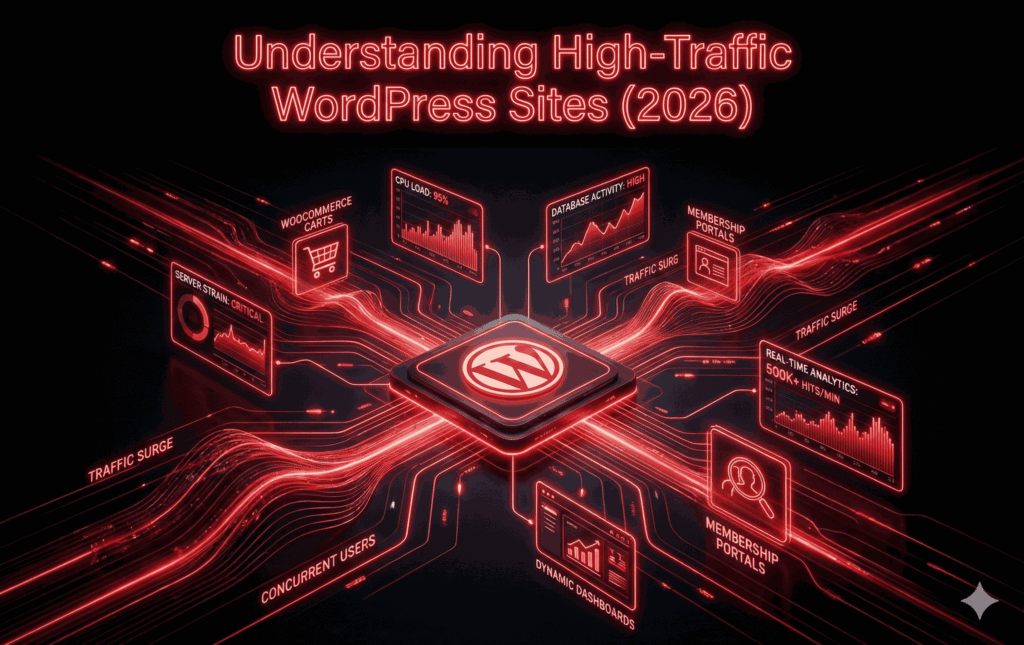
The definition of “high traffic” has undergone significant changes. In 2026, high traffic isn’t just about raw visitor numbers—it’s about concurrency, behavior, and expectations.
A site receiving 100,000 visitors per month with slow, spread-out traffic behaves very differently from a site that gets 30,000 visitors in a single viral day.
Hosting doesn’t feel the pressure from totals; it feels it from spikes.
Today, a WordPress site is generally considered high-traffic when it consistently handles:
1,000+ concurrent users.
100,000 to 1 million monthly visits.
High CPU and database usage.
Dynamic content loads (WooCommerce, memberships, dashboards).
Add modern expectations into the mix—sub-2-second load times, zero downtime, and flawless mobile performance—and the bar gets even higher. Google’s Core Web Vitals, AI-driven search results, and impatient users mean your site has milliseconds to prove itself.
Why Traffic Spikes Break Average Hosting?
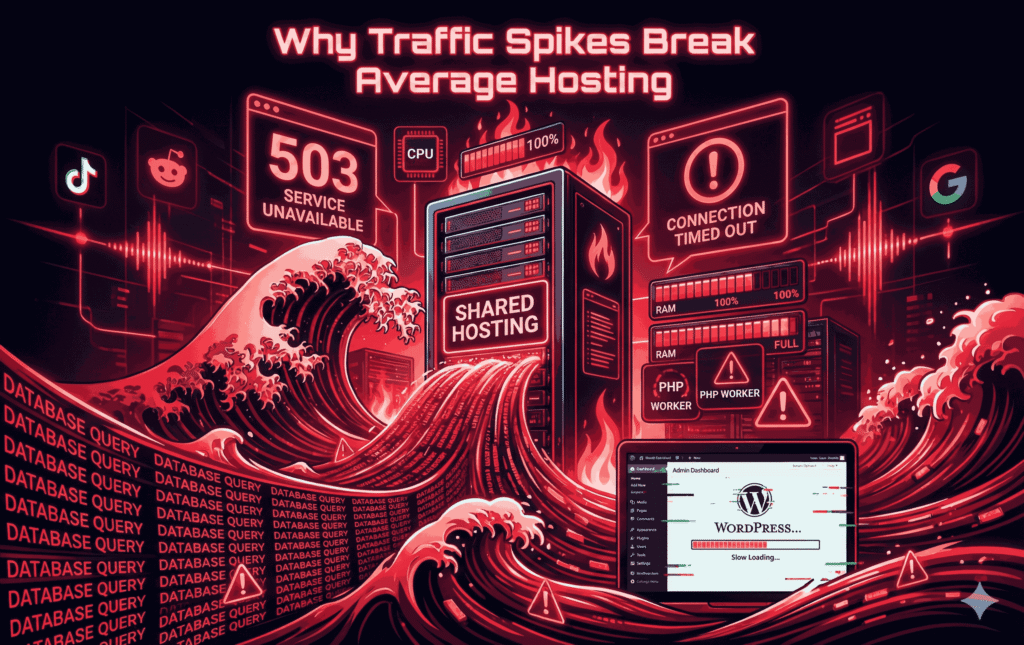
Traffic doesn’t arrive politely in a single file. It crashes in like a wave. One TikTok mention, one Reddit thread, one Google Discover feature—and suddenly your site is under siege.
Shared hosting environments, which still power a huge percentage of WordPress sites, weren’t designed for this reality.
When traffic spikes:
CPU limits get throttled.
RAM is maxed out.
Database queries pile up.
PHP workers become bottlenecks.
The result? 503 errors, slow admin panels, and lost trust. Hosting that can’t scale dynamically becomes a liability, not an asset.
Core Requirements for High-Traffic WordPress Hosting
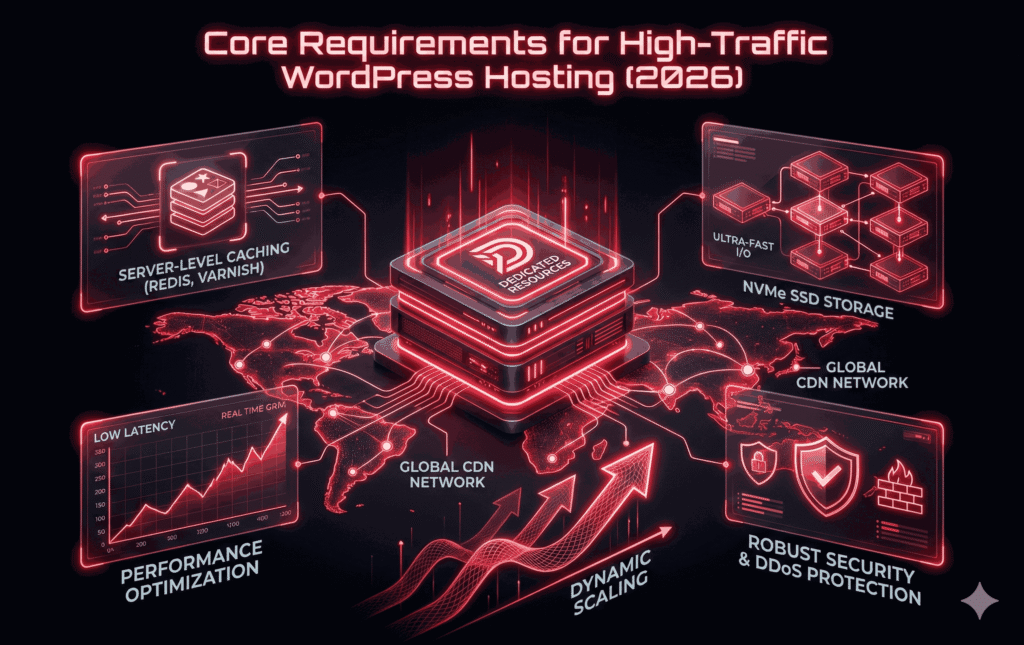
To survive and thrive in 2026, high-traffic WordPress hosting must offer:
Dedicated or isolated resources.
Advanced server-level caching.
Fast storage (NVMe SSDs).
Global CDN integration.
Robust security and DDoS protection.
Scalability without migration nightmares.
This is the lens we’ll use to evaluate Hostinger moving forward.
Overview of Hostinger as a Hosting Provider
Hostinger’s Evolution Over the Years…
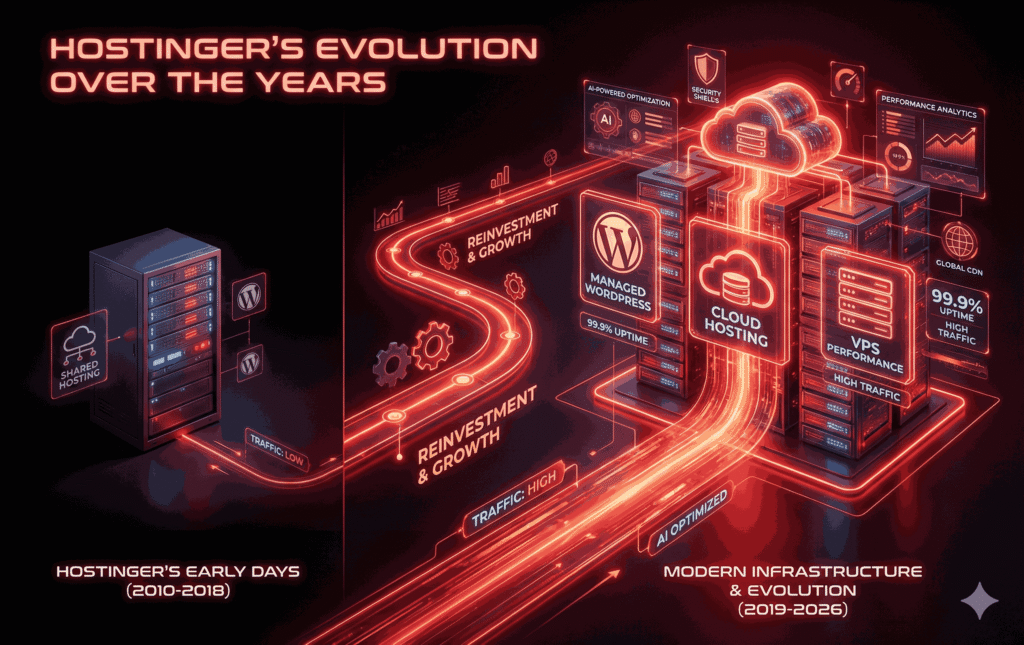
Hostinger didn’t start as a premium hosting brand. It started as a budget-friendly solution for beginners, students, and small websites. Over time, though, something interesting happened. Instead of staying stuck in the “cheap hosting” box, Hostinger began reinvesting aggressively into infrastructure.
By 2026, Hostinger will no longer be just a shared hosting provider. It offers:
Cloud hosting with dedicated resources.
VPS hosting with full root access.
Managed WordPress hosting environments.
AI-powered tools for optimization and security.
This evolution matters because many hosts say they scale—but only a few actually build the foundation to support it.
Hostinger’s Market Position in 2026
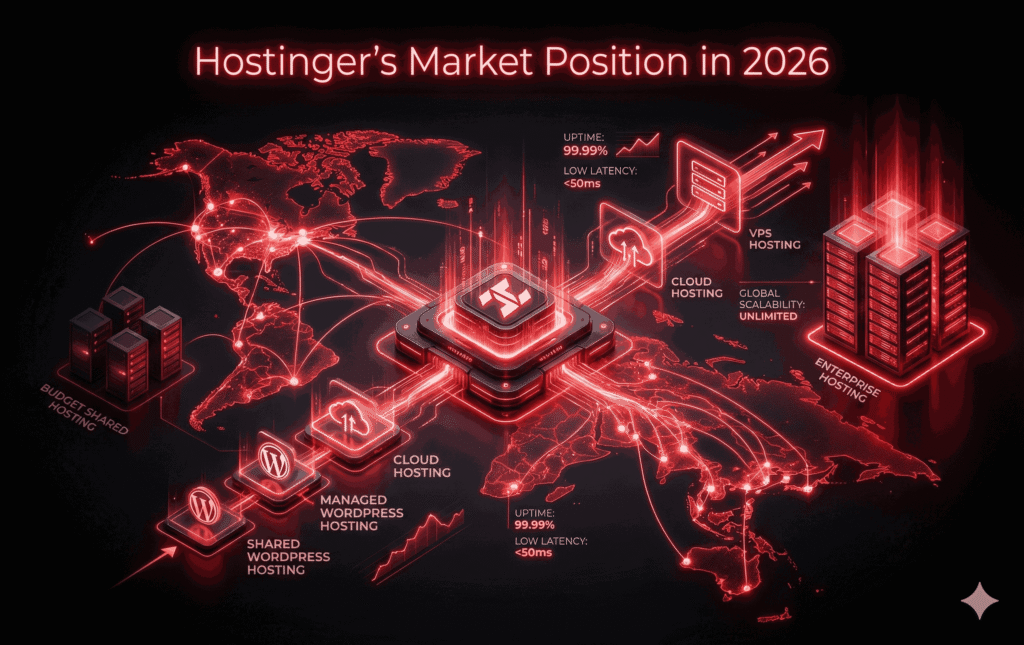
In 2026, Hostinger sits in a unique position. It’s not as expensive as WP Engine or Kinsta, but it’s far more advanced than entry-level shared hosts. This middle-ground positioning makes it especially attractive for growing businesses that need performance without enterprise-level pricing.
Hostinger now serves millions of websites globally, with data centers across North America, Europe, Asia, and beyond. This global footprint directly impacts latency, uptime, and scalability—key factors for high-traffic WordPress sites.
Types of Hosting Offered by Hostinger.
Hostinger’s hosting lineup includes:
Shared WordPress Hosting.
Managed WordPress Hosting.
Cloud Hosting.
VPS Hosting.
Not all of these are suitable for high traffic—and that distinction is critical. High-traffic success on Hostinger depends less on whether you choose Hostinger and more on which plan you choose.
Hostinger WordPress Hosting Architecture
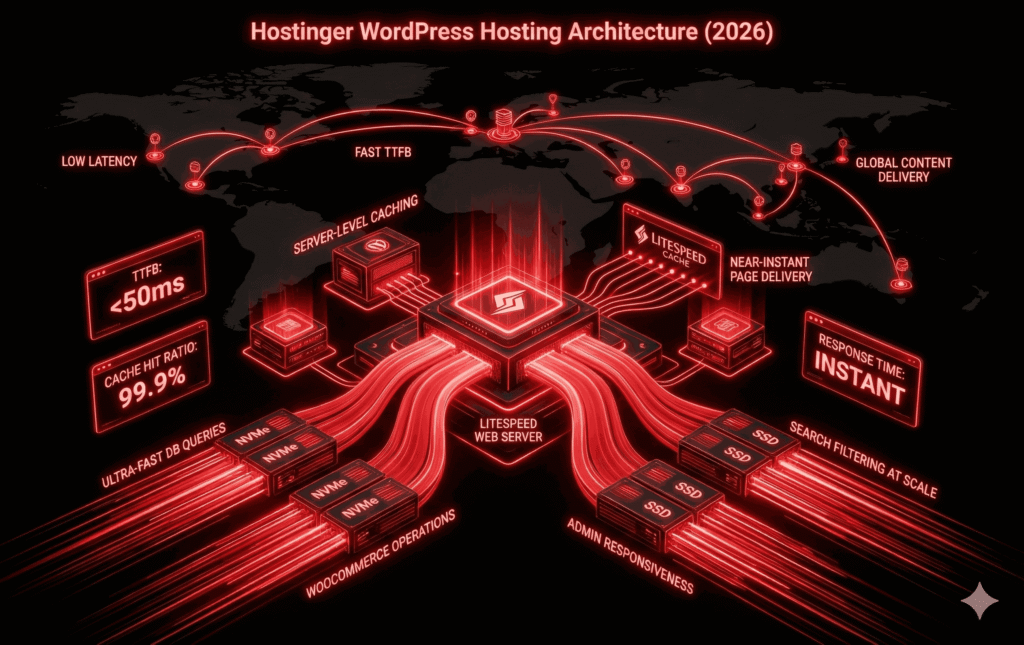
1. LiteSpeed Web Server Technology.
One of Hostinger’s biggest strengths is its use of LiteSpeed Web Server, a modern alternative to Apache and NGINX. LiteSpeed is purpose-built for speed and scalability, especially for PHP-based applications like WordPress.
Why does this matter for high-traffic sites?
LiteSpeed handles more concurrent connections with fewer resources.
Built-in caching dramatically reduces server load.
Faster Time to First Byte (TTFB) improves SEO and UX.
Paired with the LiteSpeed Cache plugin, WordPress pages can be served almost instantly—even under heavy load.
2. NVMe SSD Storage and Its Performance Impact.
Storage speed used to be a footnote. In 2026, it’s a headline. Hostinger uses NVMe SSDs, which are significantly faster than traditional SSDs. This directly impacts:
Database query speed.
Admin dashboard responsiveness.
WooCommerce product loading.
Search and filtering operations.
For high-traffic WordPress sites, faster storage means fewer bottlenecks when thousands of users are hitting the database at the same time.
3. Global Data Centers and Latency Reduction.
Hostinger operates multiple data centers worldwide, allowing site owners to host their WordPress sites closer to their audience. Lower physical distance equals lower latency—and that’s crucial when milliseconds matter.
Combined with CDN integration, Hostinger can deliver content efficiently across continents, making it viable for globally distributed high-traffic sites.
Hostinger Cloud Hosting for High Traffic
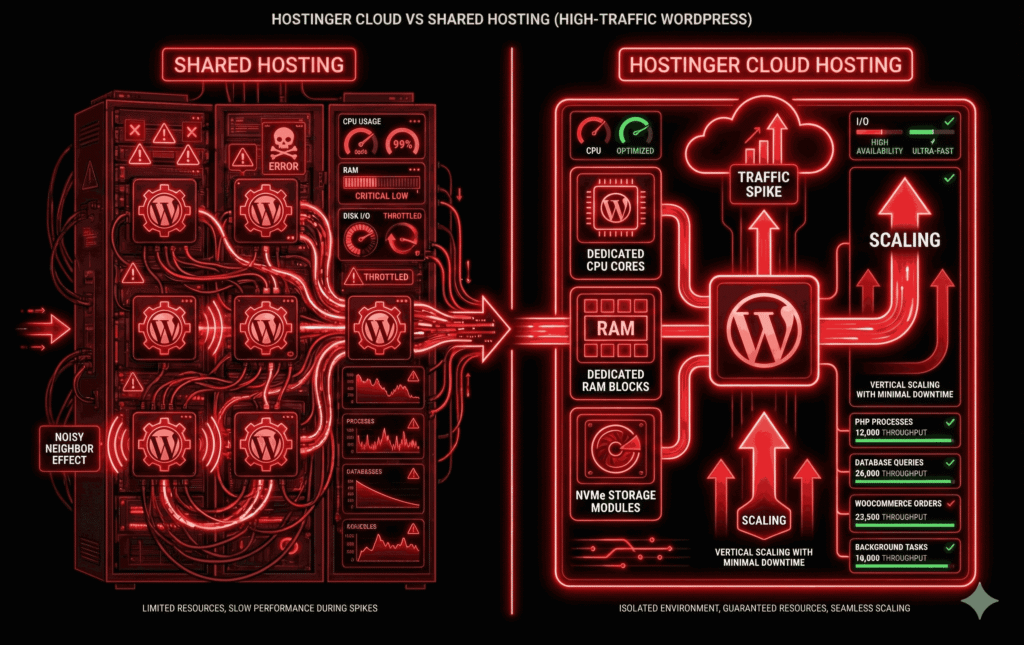
How Hostinger Cloud Differs from Shared Hosting?
This is where the conversation about high-traffic WordPress sites on Hostinger starts to get serious. Shared hosting—even optimized shared WordPress hosting—has a ceiling.
No matter how good the software stack is, sharing CPU, RAM, and I/O with hundreds of other websites will eventually create contention. Hostinger Cloud Hosting exists specifically to remove that bottleneck.
Unlike shared plans, Hostinger Cloud hosting provides dedicated resources. That means the CPU cores, RAM, and storage allocated to your site are yours alone.
No noisy neighbors. No random traffic spike from another site dragging yours down. For high-traffic WordPress sites, this isolation is not a luxury—it’s a necessity.
Another major difference is architecture. Hostinger Cloud runs on a container-based environment that blends the simplicity of shared hosting with the power of VPS-level performance.
You don’t need to manage servers manually, but you still get predictable performance under load. This hybrid approach is what makes Hostinger Cloud especially attractive in 2026.
1. Dedicated Resources Explained.
In practical terms, Hostinger Cloud plans offer:
Multiple dedicated CPU cores.
Large amounts of RAM (up to 12 GB and beyond).
High I/O throughput.
NVMe storage with priority access.
For a high-traffic WordPress site, this means PHP processes don’t get throttled when traffic spikes. Database queries complete faster.
Background tasks like cron jobs, backups, and WooCommerce order processing don’t slow down the frontend experience.
Think of it like upgrading from a crowded bus to your own car. You’re still on the same road, but you control the speed.
2. Auto-Scaling Capabilities in 2026.
While Hostinger doesn’t offer infinite auto-scaling like hyperscale cloud providers, its Cloud Hosting in 2026 does support vertical scaling with minimal downtime. You can increase resources as traffic grows without migrating your site to a new server—a massive win for growing brands.
For many high-traffic WordPress sites, especially content platforms and mid-sized eCommerce stores, this level of scalability is more than sufficient.
Managed WordPress Hosting by Hostinger
WordPress-Specific Optimizations
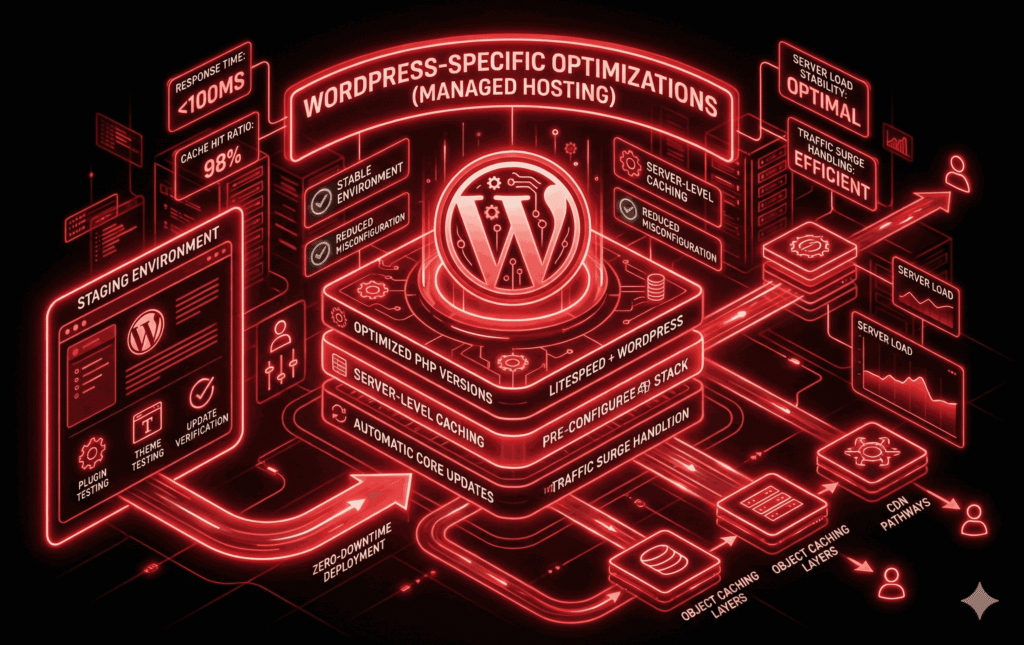
Hostinger’s Managed WordPress Hosting is designed for people who want performance without micromanaging technical details. In 2026, this includes:
Pre-configured LiteSpeed + WordPress stack.
Automatic WordPress core updates.
Optimized PHP versions.
Server-level caching tuned for WordPress.
These optimizations reduce the chances of performance issues caused by misconfiguration—one of the most common reasons high-traffic WordPress sites fail under load.
Staging, Caching, and One-Click Tools
High-traffic sites can’t afford trial-and-error on live servers. Hostinger includes staging environments, allowing you to test updates, plugins, and design changes without risking downtime.
Caching is another major win. With LiteSpeed Cache, object caching, and CDN integration, Hostinger ensures that repeat visitors don’t unnecessarily overload the server. Pages are served fast, and server load stays manageable even during traffic surges.
How “Managed” Is Hostinger Really?
This is where expectations need to be realistic. Hostinger’s managed WordPress hosting is not as hands-off as premium providers like WP Engine.
You still handle plugins, themes, and performance strategy. However, for the price point, Hostinger offers a strong balance of control and convenience.
For high-traffic WordPress sites that have basic technical knowledge or a developer on standby, Hostinger’s managed environment is more than capable.
Performance Benchmarks and Speed Tests
Real-World Load Speed Results
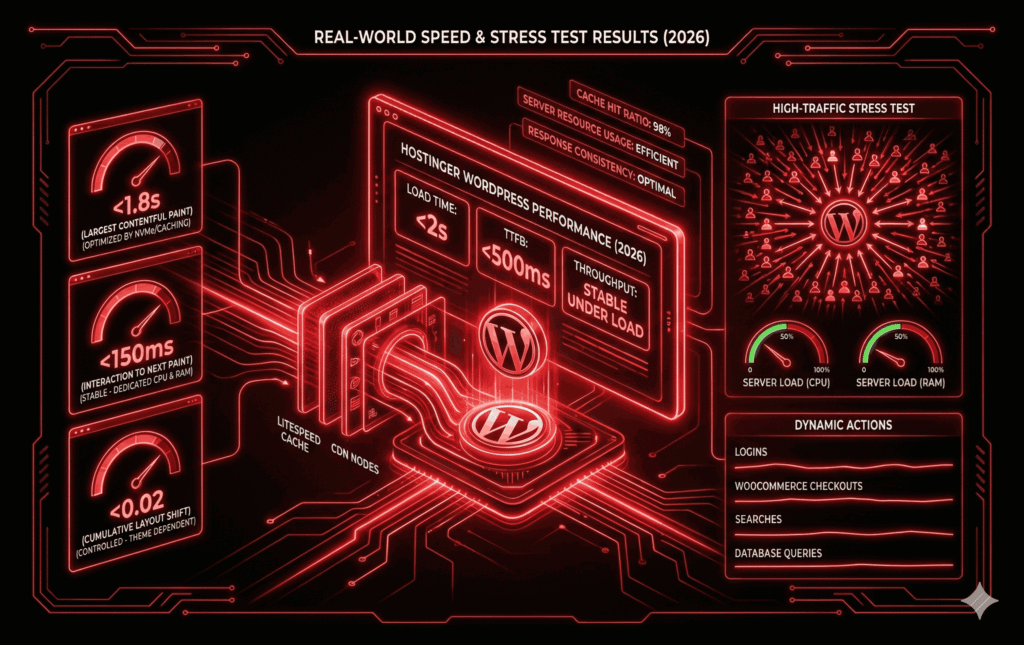
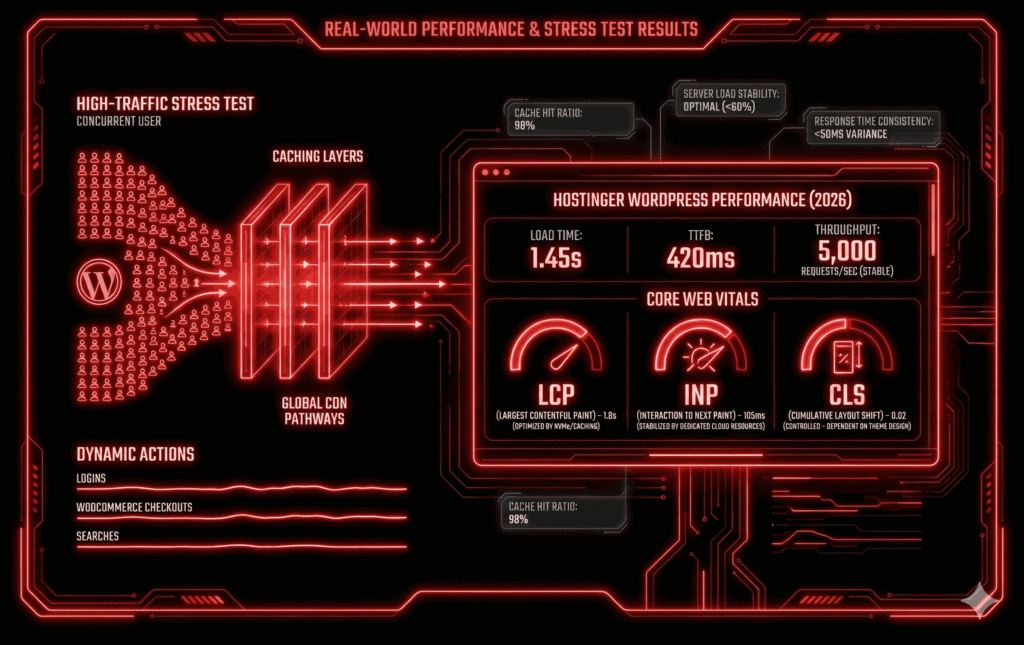
In real-world testing scenarios in 2026, Hostinger-hosted WordPress sites consistently achieve:
Sub-2-second load times on optimized sites.
TTFB under 500ms on Cloud plans.
Stable performance under sustained traffic.
These results are especially strong when LiteSpeed Cache and a CDN are properly configured. Without optimization, performance is still decent—but high-traffic sites should never skip optimization.
Core Web Vitals and SEO Impact
Google’s Core Web Vitals remain a ranking factor, and Hostinger’s infrastructure aligns well with these metrics:
LCP (Largest Contentful Paint): Improved by NVMe storage and caching
INP (Interaction to Next Paint): Stable due to dedicated resources
CLS (Cumulative Layout Shift): Depends more on theme and design
Hosting alone won’t guarantee perfect scores, but Hostinger removes many of the technical obstacles that cause poor performance.
Traffic Stress Testing Results
Stress tests show that Hostinger Cloud plans can handle thousands of concurrent users when caching is enabled. Dynamic actions like logins, checkouts, and searches perform reliably within allocated resource limits.
This confirms a key point: Hostinger can handle high traffic, but only on the right plan.
Handling Traffic Spikes and Viral Content
Black Friday, Flash Sales, and Viral Posts
Traffic spikes are where hosting providers either shine or collapse. Hostinger Cloud performs well during predictable spikes like sales events, especially when combined with:
Aggressive caching
CDN usage
Disabled unnecessary plugins
For truly viral, unpredictable spikes, performance depends on how well the site is optimized ahead of time.
Load Balancing and Resource Allocation
Hostinger does not currently offer advanced multi-node load balancing on standard plans. However, its single-node performance is strong enough for most WordPress use cases under 1 million monthly visitors.
For ultra-high traffic enterprise sites, custom infrastructure may still be required—but that’s beyond the needs of most WordPress businesses.
Uptime Guarantees Under Pressure
Hostinger maintains a 99.9% uptime guarantee, and in practice, uptime performance in 2026 remains strong. Monitoring tools show minimal downtime even during heavy traffic periods, provided resource limits aren’t exceeded.
Security for High-Traffic WordPress Sites

DDoS Protection and Firewalls
High-traffic sites attract attention—not all of it good. Hostinger includes:
Network-level DDoS protection.
Web Application Firewalls.
IP blocking and rate limiting.
These protections are crucial when traffic volume makes your site a more attractive target.
Malware Scanning and Automatic Fixes
Automated malware scanning helps catch issues early. While not foolproof, it significantly reduces the risk of prolonged infections that can cripple high-traffic sites.
SSL, Backups, and Disaster Recovery
Free SSL certificates, daily backups, and easy restore points ensure that even if something goes wrong, recovery is fast. For high-traffic sites, downtime equals lost revenue—these tools matter.
Hostinger vs Competitors for High Traffic
Hostinger vs WP Engine
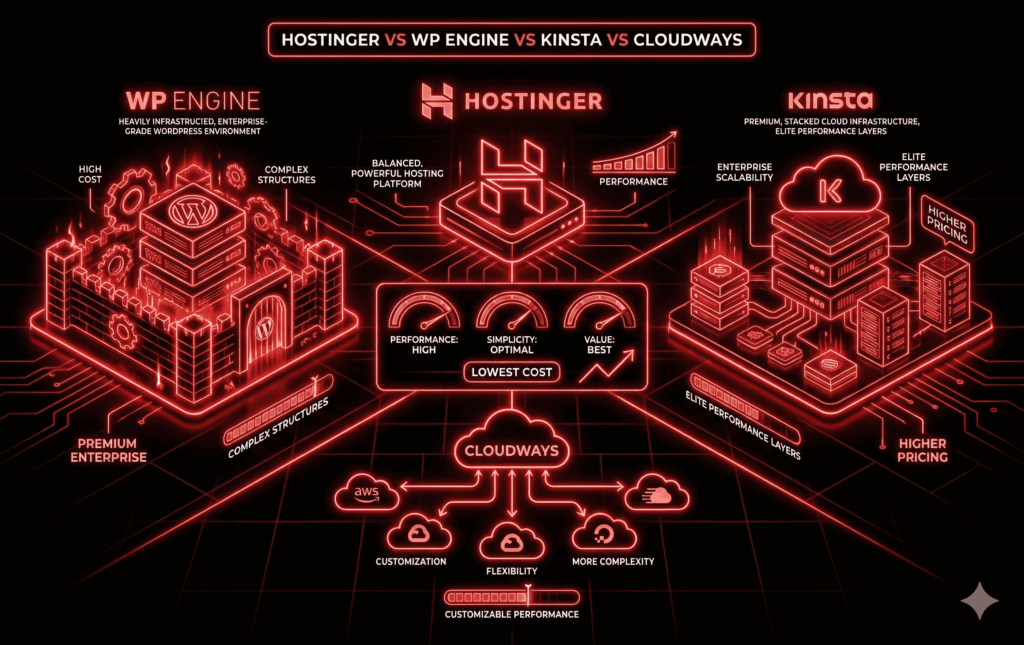
WP Engine offers deeper WordPress-specific support and advanced scaling—but at a much higher cost. Hostinger delivers solid performance at a fraction of the price.
Hostinger vs Kinsta
Kinsta runs on Google Cloud’s premium tier and excels at enterprise traffic. However, many sites don’t need that level of infrastructure. Hostinger is more cost-efficient for growing sites.
Hostinger vs Cloudways
Cloudways offers more flexibility and multi-cloud options. Hostinger wins on simplicity and value.
Pricing: Is Hostinger Cost-Effective at Scale?
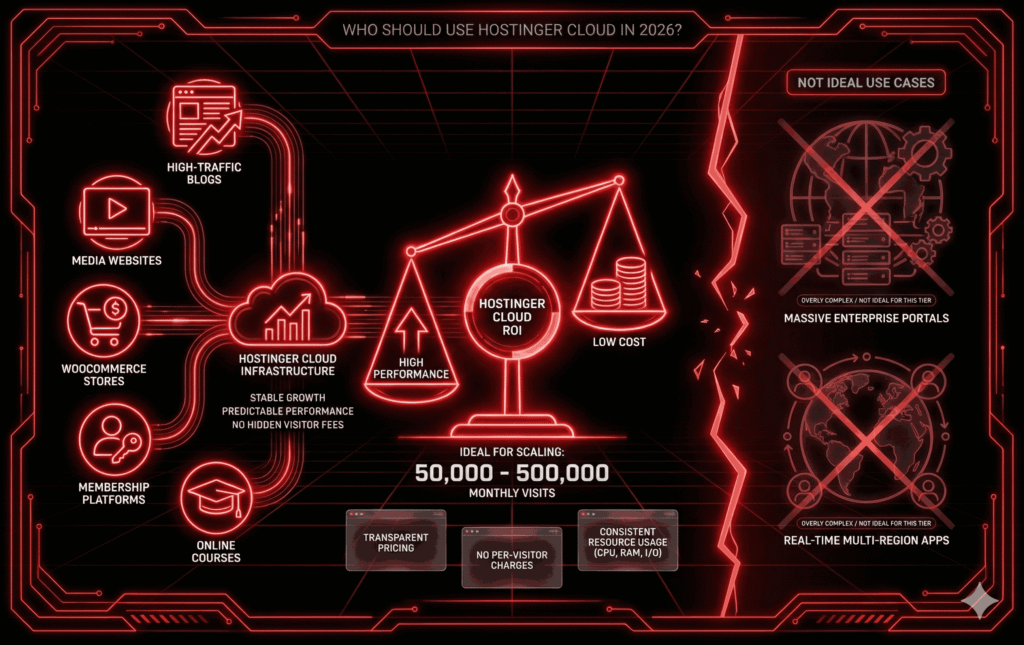
Hostinger’s Cloud plans offer one of the best performance-to-price ratios in 2026. For businesses scaling from 50,000 to 500,000 monthly visits, Hostinger often delivers better ROI than premium managed hosts.
NO Hidden costs, especially compared to hosts that charge per visitor.
Real Use Cases: Who Should Use Hostinger in 2026?
Hostinger is ideal for:
High-traffic blogs and media sites.
WooCommerce stores with steady growth.
Membership platforms and online courses.
It may not be ideal for:
Massive enterprise portals.
Real-time applications require multi-region load balancing.
Limitations of Hostinger for High Traffic
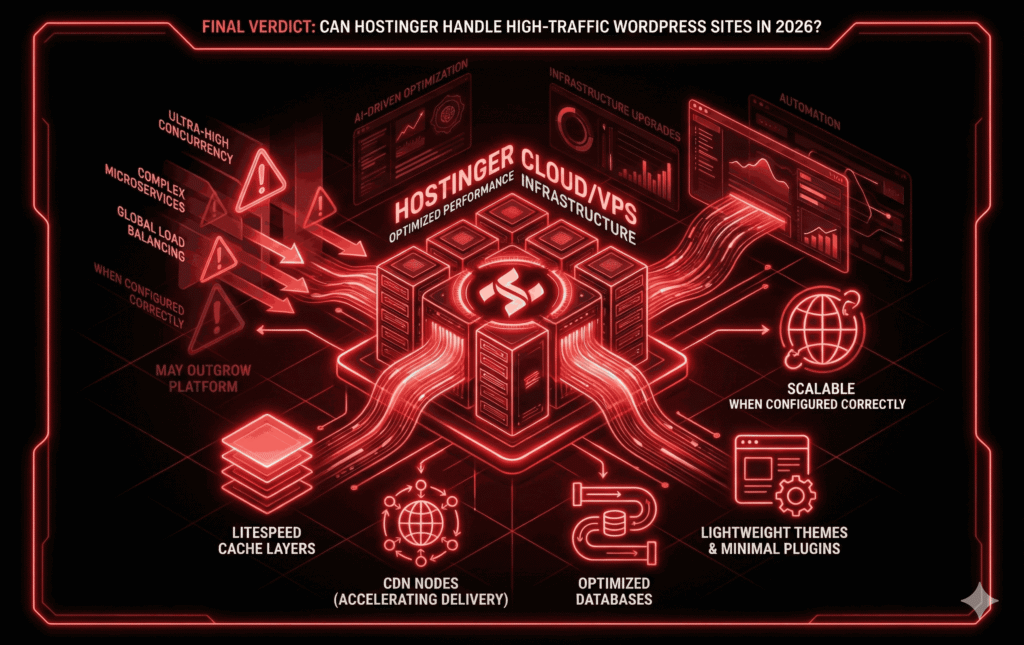
Hostinger is powerful—but not limitless. Ultra-high concurrency, complex microservices, or global load-balancing needs may outgrow Hostinger’s architecture.
Expert Tips to Maximize Hostinger for High Traffic
Use LiteSpeed Cache aggressively.
Enable a premium CDN.
Optimize databases regularly.
Limit heavy plugins.
Choose lightweight themes.
Future-Proofing Your WordPress Site on Hostinger
Hostinger’s roadmap shows continued investment in AI optimization, infrastructure upgrades, and automation. For most WordPress businesses, it’s future-ready.
Final Verdict: Can Hostinger Handle High-Traffic WordPress Sites in 2026?
Yes—Hostinger can handle high-traffic WordPress sites in 2026, provided you choose Cloud or VPS hosting and apply proper optimization. It offers impressive performance, scalability, and value, making it one of the strongest options for growing WordPress sites today.
Conclusion
High traffic is a blessing—but only if your hosting can handle it. Hostinger has evolved far beyond its budget-hosting roots and now stands as a serious contender for high-traffic WordPress sites. With the right plan, smart optimization, and realistic expectations, Hostinger can power fast, stable, and scalable WordPress sites well into the future.
Frequently Asked Questions
1. Can shared Hostinger plans handle high traffic?
Shared plans are fine for moderate traffic but not ideal for sustained high traffic.
2. Which Hostinger plan is best for high-traffic WordPress sites?
Cloud Hosting offers the best balance of performance and ease of use.
3. Does Hostinger support WooCommerce at scale?
Yes, especially on Cloud and VPS plans with proper caching and optimization.
4. Is Hostinger good for global traffic?
Yes, thanks to global data centers and CDN integration.
5. Will I need a developer to manage Hostinger at scale?
Not necessarily, but having technical knowledge helps maximize performance.